Svetlana Prodius

Speak Pro

Speak Pro turns YouTube videos into speaking lessons with voice recording and pronunciation feedback.

Why we built

I saw that most language apps focused on beginners, so I shaped Speak Pro for B1–B2 learners who need an accessible way to keep practising and progressing through YouTube content in 12 languages. 44 shadowing studies ↗

Team

I co-founded Speak Pro and led product, design and marketing. My co-founder led software development, and together we covered the remaining functions.

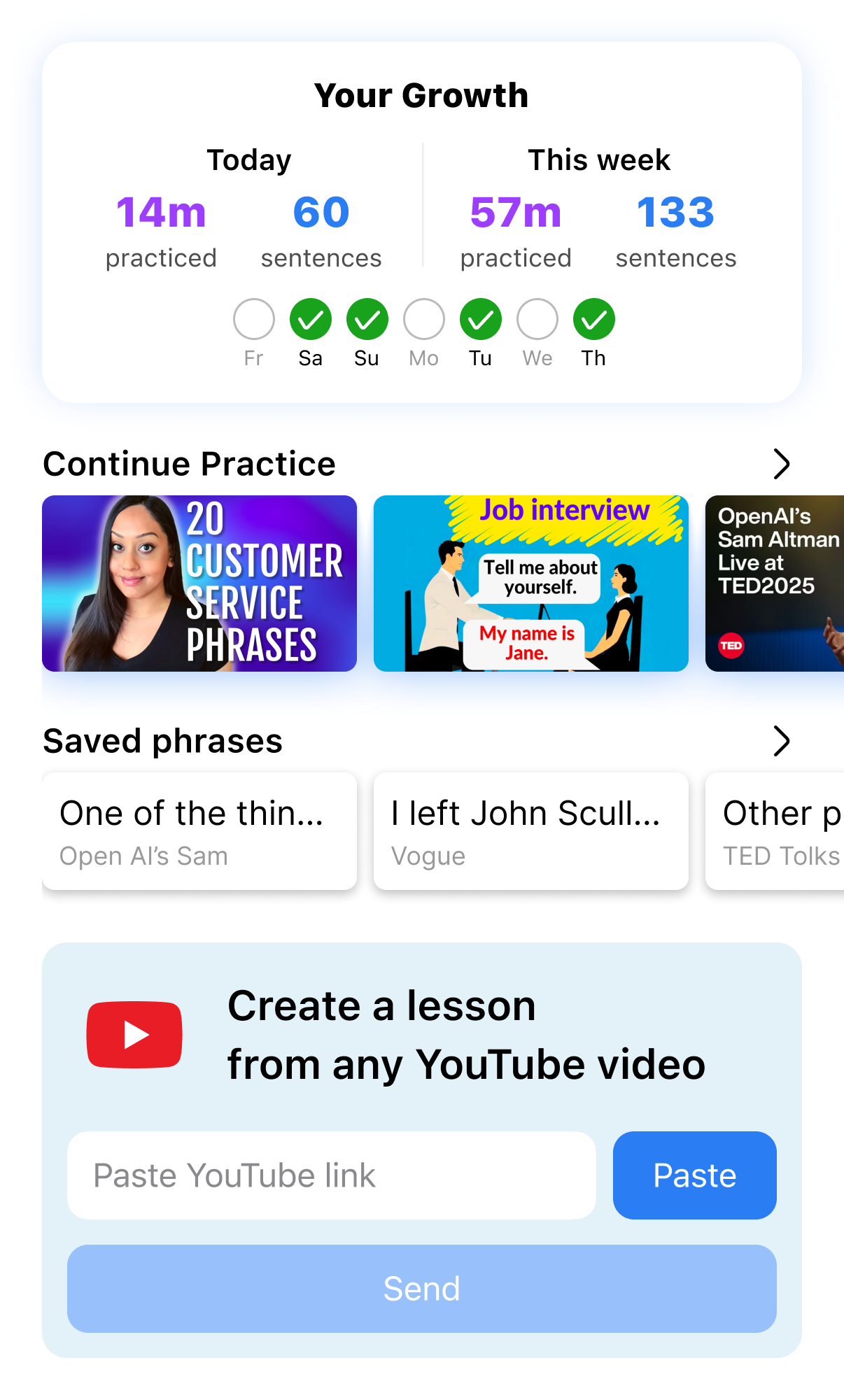
Speak Pro home screen with practice progress, saved phrases and videos
Role
Co-founder, Product Designer & Product Manager
MVP
Launched in 2 months
Audience
100K

Our users

Three situations show when learners need Speak Pro.

01 · Use case

Build speaking confidence

An intermediate learner understands the language but does not use it often enough.

Problem
I understand English, but when I need to say something, my mind goes blank. The words just don’t come.
Alternatives
Regular lessons with Preply ↗, conversation partners on Tandem ↗, or language exchange through HelloTalk ↗.
Need
Practise retrieving familiar words quickly in a low-pressure setting.

02 · Use case

Professional vocabulary

An advanced learner needs language for a specific field such as medicine or software development.

Problem
I can speak confidently about everyday topics, but I don’t know how to make professional vocabulary part of the language I actually use.
Alternatives
Professional courses on Coursera ↗, vocabulary sets in Quizlet ↗, or specialist channels on YouTube ↗.
Need
Use professional terminology repeatedly in realistic spoken contexts.

03 · Use case

Avoid awkward self-talk

A learner wants to practise speaking independently but needs a ready-made topic.

Problem
Talking to myself feels awkward, and writing a script just to practise takes too much effort.
Alternatives
Scripted practice in EWA ↗, pronunciation coaching with Speechling ↗, or open conversation in ChatGPT ↗.
Need
Start with a ready-made topic and model phrase instead of inventing a monologue.

Product cases

Save to favourites

1 · Research

2 · Findings

Target metricSeven-day revisit rate: at least 25% of learners who save a phrase return to practise it within seven days.

3 · Solution

I designed one compact flow: save a phrase during a lesson, find it grouped by source video, practise it, return to the original lesson or remove it.

4 · Results

Pronunciation feedback

1 · Research

2 · Findings

Target metricIncrease the average number of sentences practised per user by 40%.

3 · Solution

4 · Results

Course

2 · Findings

Target metricIncrease first-lesson activation by 15% to improve retention and reduce churn.

3 · Solution

4 · Results

Customer research · Interview report

How learners practise speaking

I explored what prevents intermediate and advanced learners from turning language knowledge into regular speaking practice.

12participants
14interview questions
45 minaverage session
3 weeksMay–June 2025

Methodology

I conducted five remote and seven in-person interviews with B1–B2 learners. None of the participants were familiar with the shadowing method. In the second half of each session, participants tested an interactive prototype and completed a short task; I coded their responses by situation, problem, alternative and need.

Example interview questions

  1. Tell me about the last time you wanted to speak the language but could not practise.
  2. What were you trying to say, and where did you get stuck?
  3. How do you currently practise speaking on your own?
  4. Which apps, tutors, videos or other alternatives have you tried?
  5. What makes you stop or postpone a speaking session?
  6. Show me how you would use this prototype to practise one phrase.

What learners said

I understand English, but when I need to say something, my mind goes blank.
I know the professional words, but I never use them naturally in conversation.
I often have no suitable place or time to practise speaking aloud.
Repeating after a video feels awkward when the speaker keeps moving on.
I want to repeat phrases from Instagram videos, not only long YouTube lessons.
Sometimes I paste a link and it simply does not work.
I cannot always find a video that is interesting enough to repeat several times.
The voice recognition sometimes marks words incorrectly even when I say them clearly.
I want feedback, but I also want to hear my own recording next to the original.
Talking to myself feels strange when I have to invent the topic as well.

Research synthesis

ThemePeople
No suitable time or place to speak5
Needs specific terminology5
No regular speaking partner7
Awkward to repeat after a video6
Videos move too fast to repeat8
YouTube link does not work4
Wants to repeat after an Instagram video6
Cannot find interesting videos to repeat7
Voice recognition is inaccurate5
Wants pronunciation feedback9

Design & engineering

Design System

I created visual foundations, reusable components and interaction patterns in Figma, then documented them for AI-assisted design and development tools.

Foundations

I defined colour, typography, spacing and iconography as shared foundations for Figma and AI-assisted implementation.

The same visual rules keep generated interfaces consistent across screens.

Components

I specified lesson cards, playback and recording controls, buttons, feedback patterns and saved states.

Each component includes its purpose, expected behaviour and acceptance criteria.

Interaction states

I mapped playback, recording, feedback and saving across default, loading, empty, error and completed states.

The flows also cover interruptions, recovery and transitions between steps.